Start with the optimizer, because that is where most of the lift comes from. Aurora is a leverage-aware successor to Muon. Muon orthogonalizes every weight update, but on tall rectangular matrices it inherits the momentum buffer's row-norm anisotropy, so a large share of neurons go dead early and stay dead, a rich-get-richer collapse. Aurora relaxes the row-norm target to a value compatible with orthogonality, keeping every neuron alive while preserving the polar step. Drop-in, a few percent overhead.
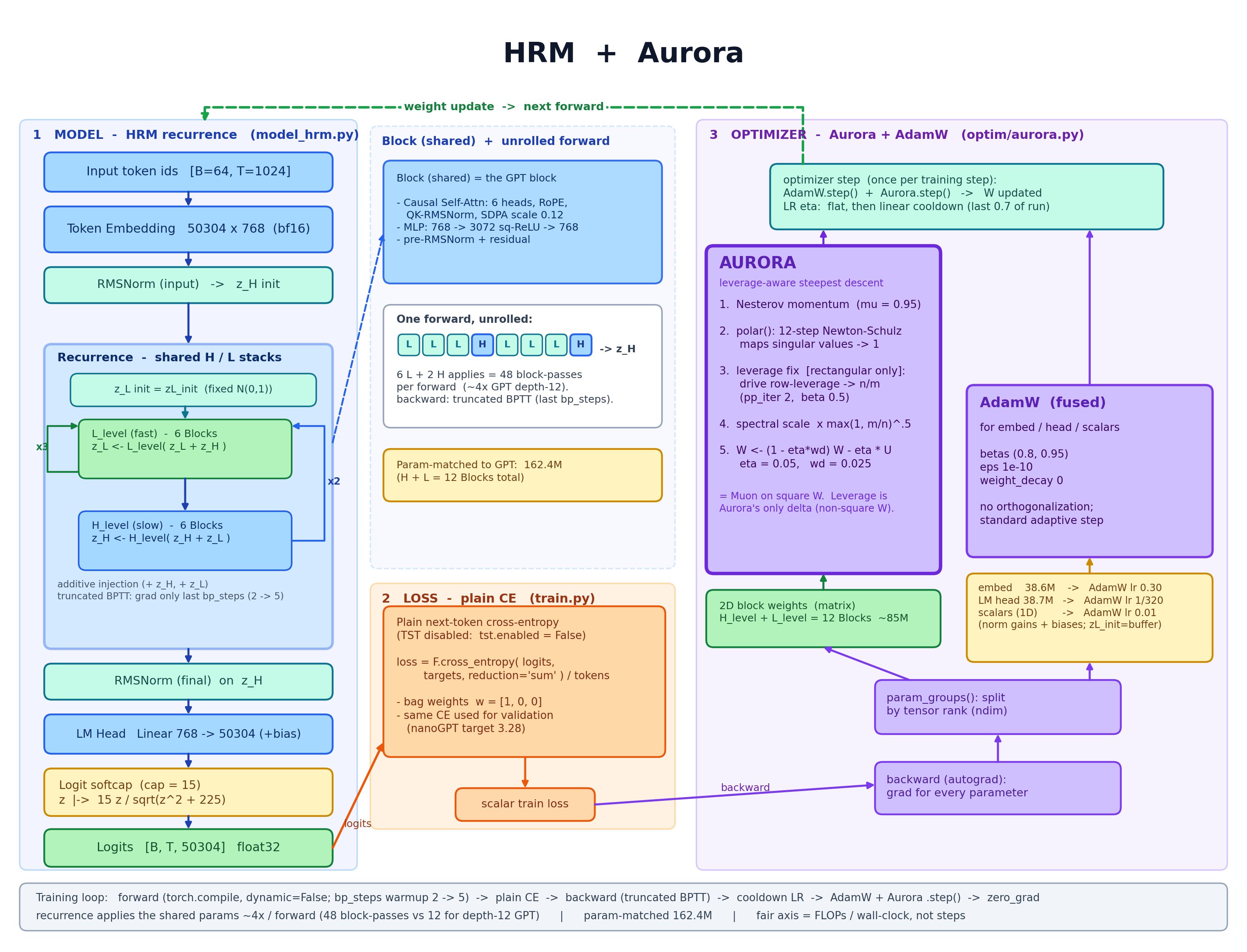
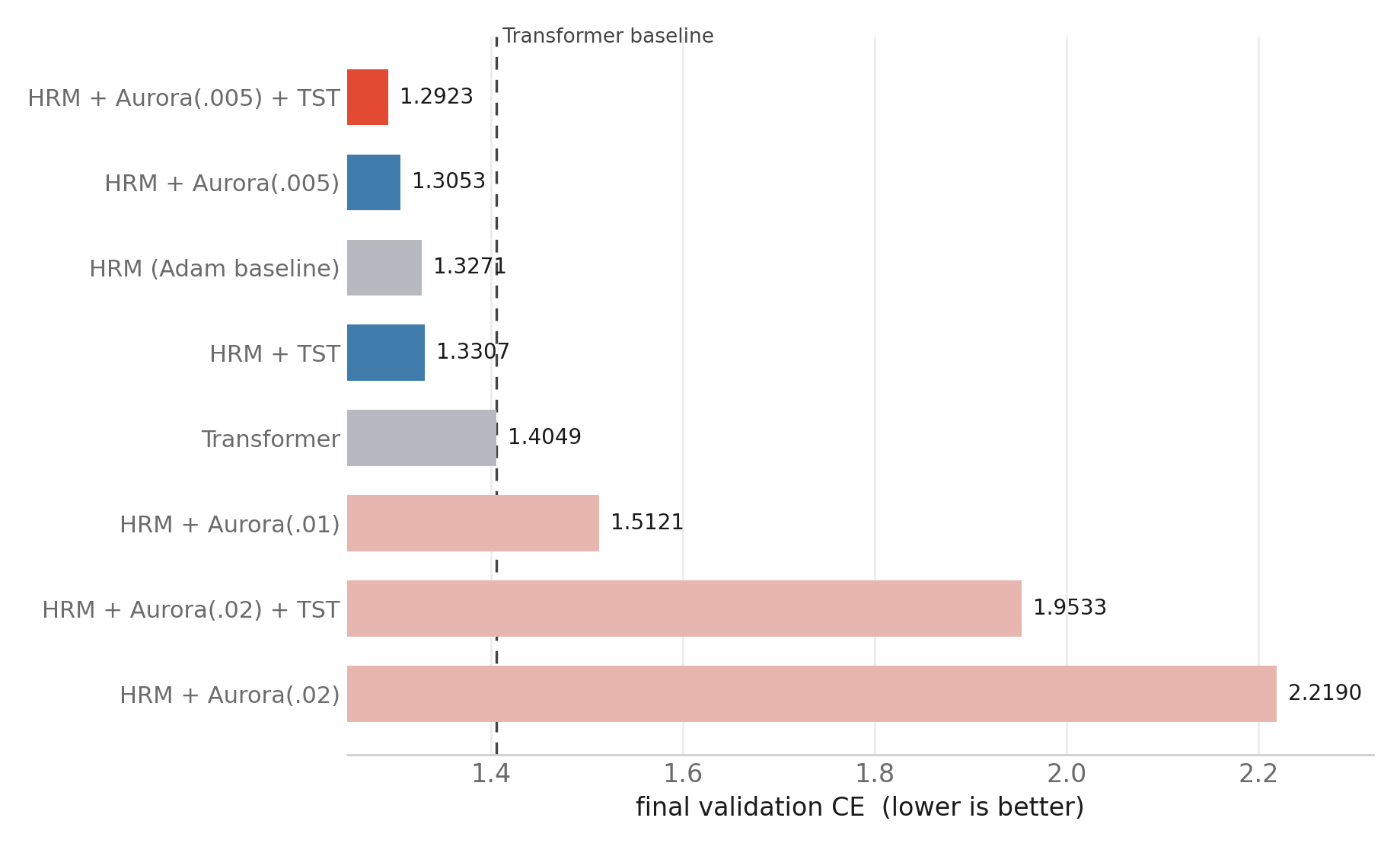
Now put it under a recurrent reasoner in its native regime. In response-only PrefixLM, the task-completion objective HRM was built for, the result reverses: HRM beats a same-budget Transformer by 0.078 validation CE (1.327 vs 1.405), and tuned Aurora pushes it further, to 1.305. The recurrent core reuses its weights many times per pass, exactly the setting where Aurora's refusal to let neurons die compounds.
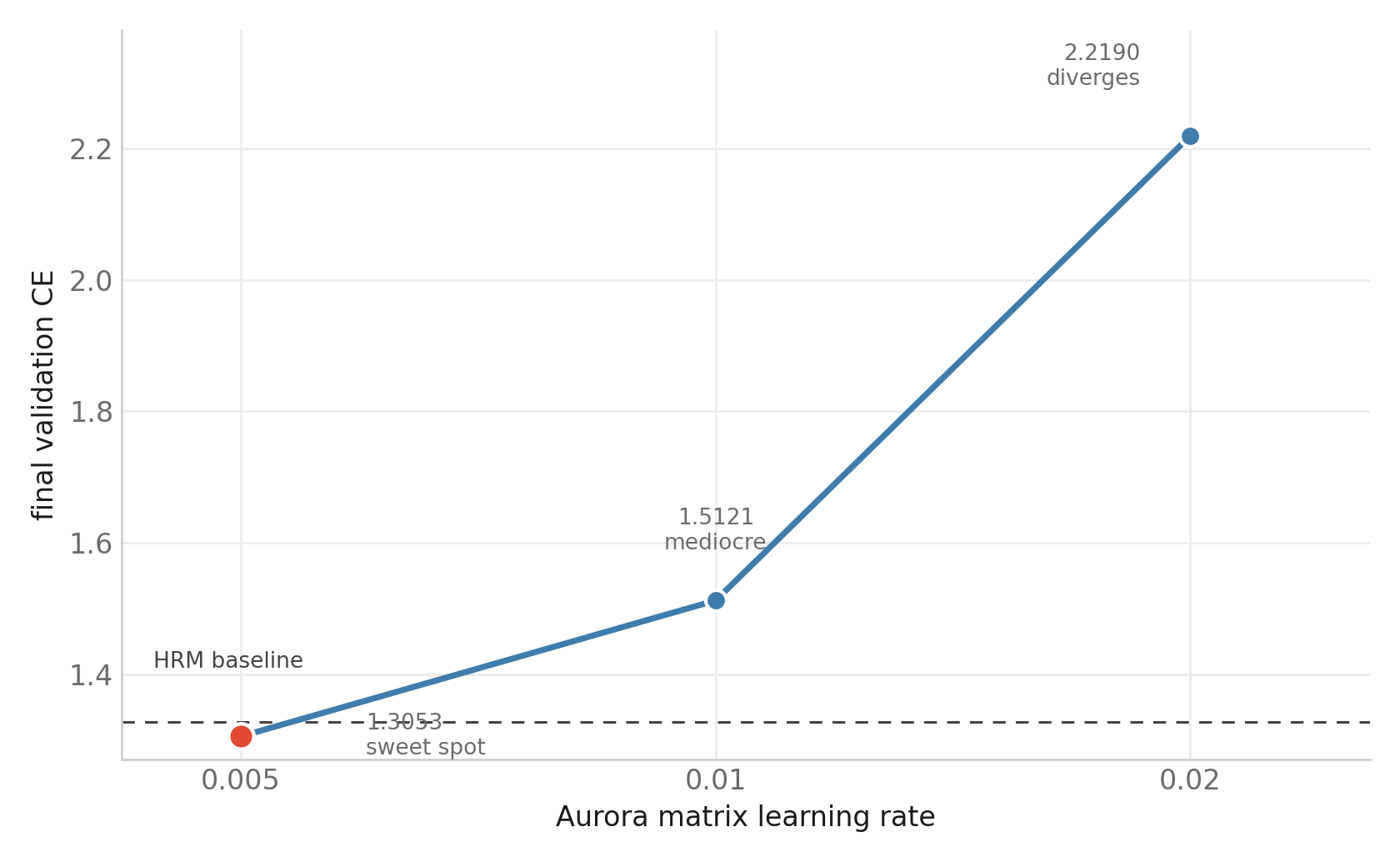
One caution: Aurora's learning rate is decisive. 0.005 is the sweet spot, 0.01 is mediocre, 0.02 diverges outright. The optimizer that gives the most can also break the run if you mistune it.
We also tried fold-TST on top. The gain is small and conditional: it slightly hurts plain HRM and only helps once Aurora is tuned, taking the full stack to 1.292. We are not convinced that edge is worth the extra machinery, so it stays an open question, subject to further experiment.
One honest caveat: this lead is in step efficiency, the recurrent core runs slower per step. But if the next round of frontier reasoning comes from small recurrent cores trained well rather than ever-larger dense stacks, HRM + Aurora is where I would place the first bet.