The fourth-order effect, field by field — what happens to the capitalisation of products in theoretical physics, drug discovery, materials, chips, and cryptography once AI does the research itself
The one law — and why it has to be applied field by field
The Erdős result proved something narrow and exact: AI can now autonomously do the reasoning-bottlenecked part of discovery, the part where a trained mind searches for a construction, a proof, a model that fits.
Every research field is two halves bolted together:
- a reasoning half, theory, design, derivation, the search for the right idea;
- a physical-world half, experiment, synthesis, fabrication, the clinical trial, the thing that must happen in atoms and time.
AI commoditises the reasoning half. That is what the Erdős solve demonstrated. So the fourth-order effect on the capitalisation of products is mechanical to derive, if you do it per field:
Find the wall between a field's reasoning half and its physical-world half. AI floods the reasoning half until it is free. One hundred percent of the capital value then slams onto the physical-world wall, and onto whoever owns or gates it.
The wall sits in a completely different place in physics than in pharma than in chips. The fields follow, theoretical physics first because it is the most exposed, and the strangest.
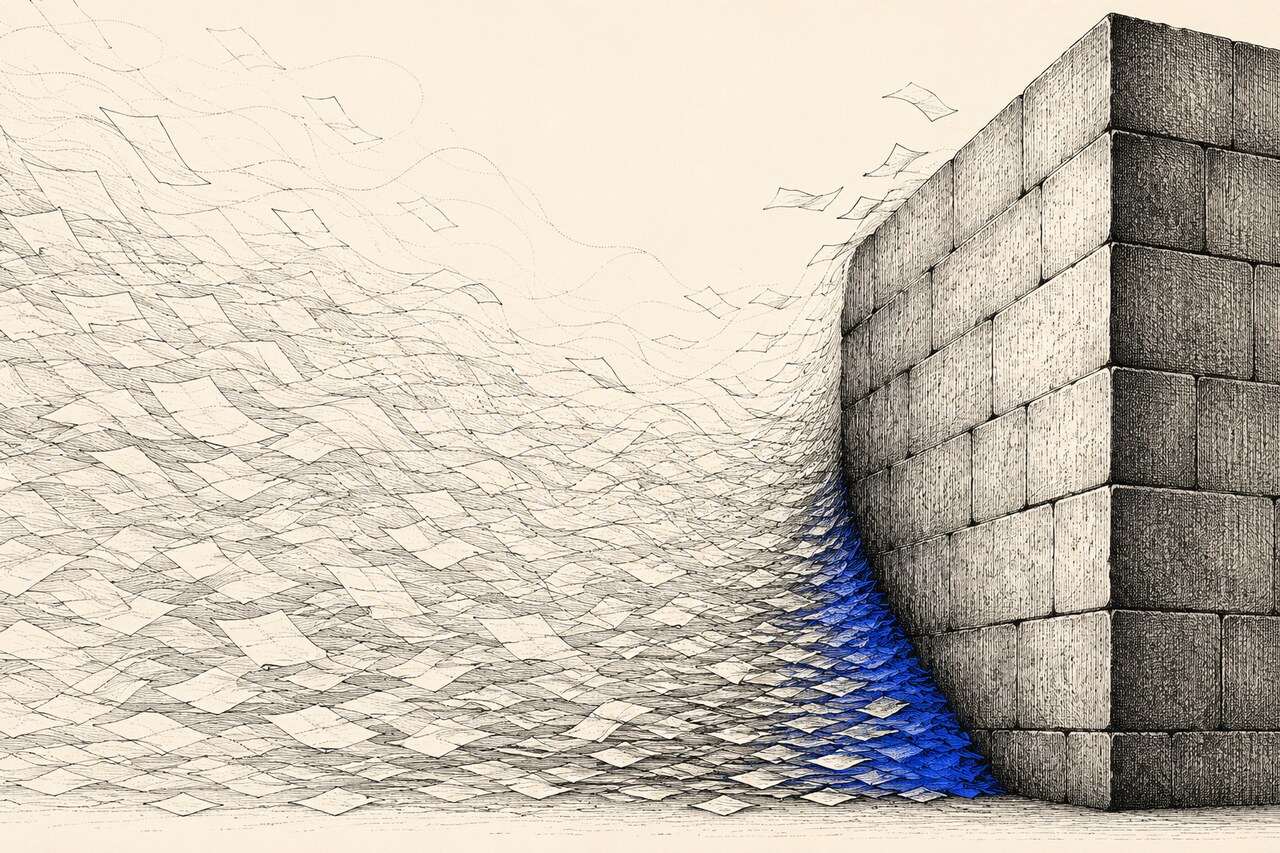
Figure 1. The wall, and where it sits in each field. Each field is a bar split into the reasoning half AI now commoditises and the physical-world wall where capital re-pools: experiment, qubit fabrication, the Phase-2 trial, synthesis, the fab. Cryptography is the exception, it has no wall.
Field 1 · Theoretical physics — the glut
This stopped being hypothetical in early 2026. A Google team's neuro-symbolic system, the Gemini Deep Think model wrapped in a tree search with automated numerical feedback, autonomously derived novel analytical solutions for the gravitational radiation emitted by cosmic strings, an open problem in general relativity. Brown University's "Albert" framework autonomously navigates the combinatorial space of beyond-Standard-Model particle theories. Reinforcement learning now drives the conformal bootstrap, re-deriving conformal field theories like the 2D Ising model from scratch. An AI agent matched gold-medalists at the 2025 International Physics Olympiad.
The reasoning half of theoretical physics is being eaten now.
But theoretical physics has the hardest wall in this entire brief, and it is worth stating precisely:
A mathematical proof certifies itself. A physical theory does not.
The Erdős proof was checked by nine mathematicians with pencils, logic is its own referee, so the discovery and its verification happen in the same medium. A theory of physics is verified only by Nature, and Nature answers through apparatus: a collider, an interferometer, a telescope, a cryostat. AI can generate ten thousand candidate theories of quantum gravity in a weekend. The LHC tests roughly one energy regime per decade.
So the fourth-order effect in theoretical physics is a glut. Theory goes superabundant and free; experimental verification stays fixed, slow, and ferociously capital-intensive. Capital and prestige drain out of the theorist and slam onto the instrument, the detector, the telescope array, the national lab, and onto the proprietary experimental data that can adjudicate between the AI's flood of candidate theories. The capitalised asset of physics was never really "a theory"; now it is unmistakably the apparatus and the dataset.
And the capital story forks:
- Knowledge-physics (quantum gravity, cosmology, high-energy theory). No product, no fast referee. AI produces theory faster than any experiment can falsify it, much of it structurally unfalsifiable at the rate it appears. There is almost nothing to capitalise. This part of physics gets intellectually faster and economically flat: the only assets are the experiments, and they do not get cheaper.
- Device-physics (condensed matter, quantum information, photonics). Here theory has a product, and the sharpest case is the quantum computer. The single most product-relevant slice of theoretical physics is the design of quantum error-correcting codes, a combinatorial-construction problem, a direct cousin of the unit-distance problem. AI is already doing it: reinforcement learning discovered new low-weight QEC codes in early 2025. If AI keeps compressing the road to fault tolerance, it directly re-prices every quantum-computing company, IBM, Google Quantum AI, IonQ, Quantinuum, PsiQuantum, QuEra. But the wall holds even here: a code is design; a qubit is a physical device that must be fabricated and cooled. The error-correction theory commoditises; the value lands on whoever can build and operate the machine.
Capitalisation of products, theoretical physics: was the theory and the theorist's reputation → becomes the apparatus, the experimental dataset, and, in device-physics, the fabricated, operating machine.
Field 2 · Drug discovery — the molecule was never the asset
Pharma is the purest "capitalisation of products" case in the economy, because a drug product literally is a capitalised intangible: a patent on a molecule. Average cost ~$2.6 billion and 10–15 years per new drug; a $200 billion revenue cliff looms by 2030 as blockbuster patents expire.
AI eats the reasoning half hard: target identification, protein structure (AlphaFold), generative chemistry, candidate design. It is genuinely good at Phase 1, safety and pharmacokinetics, 80–90% predictable.
The wall is Phase 2: human efficacy, "where promising science meets harsh biological reality," success rate stuck near 40%, and it cannot be reasoned away because a human body is the referee and a trial runs for years. AI does not get to think a body's response into existence.
So the fourth-order repricing is specific. AI makes candidate molecules near-infinite and near-free, which means the molecule and its patent lose their moat: if a model can generate ten thousand viable molecules around your composition-of-matter patent, the patent thicket stops being a wall. The classic pharma asset deflates. Value slams onto:
- clinical-trial execution capacity and patient access, note that 80% of trials already miss enrollment;
- proprietary clinical and biological data, the one input AI cannot synthesise;
- regulatory approval itself as the real moat.
The $2.6B-per-drug number barely falls, because the cost was always the trial, never the molecule. Watch the AI-native players, Recursion, Isomorphic Labs, Insilico, they are, correctly, racing to own data and trial throughput, not molecules.
Capitalisation of products, pharma: was the molecule patent → becomes the trial network, the clinical dataset, and regulatory approval. More shots on goal, each worth far less, value concentrated in whoever can actually run the trials.
Field 3 · Materials & chemistry — discovery becomes a public good
DeepMind's GNoME predicted ~2.2 million new crystals and ~380,000 stable materials, described as "nearly 800 years of knowledge", in one model run. The reasoning half of materials science (predicting that a material exists and is stable) is already commoditised.
The wall is synthesis: actually making the compound, at scale, and characterising it, what the literature bluntly calls a "slow and expensive bottleneck gauntlet" of months per compound. Knowing a material exists is now free; making it is not.
Fourth-order effect: the catalogue of known materials collapses into a public good, no moat in discovery, no value in the formula. The old asset, the proprietary formulation held as a trade secret, is dead. Value slams onto the autonomous synthesis foundry, robotic, high-throughput labs, onto manufacturing scale-up, and onto qualification data. The capitalised asset of a materials company becomes the foundry, not the formula.
Capitalisation of products, materials: was the secret formulation → becomes the synthesis foundry and the qualification dataset.
Field 4 · Semiconductors — the fab eats everything
Chip design, floorplanning, architecture search, the whole EDA stack, is reasoning-heavy and already AI-assisted; autonomous design is close.
The wall is the fab. A leading-edge fabrication plant is $20–40 billion of physical capital, a decade of process tacit knowledge, and a single extreme-ultraviolet lithography supplier (ASML). You cannot reason a 2nm fab into existence.
So autonomous chip design intensifies the existing concentration rather than disrupting it. Design IP, the fabless moat, the architecture licence, erodes as AI commoditises it; TSMC and ASML and leading-edge capacity capture even more. And there is a recursive kicker unique to this field: better AI → better chip design → better chips → better AI, but the fab gates the entire loop. Whoever controls leading-edge fabrication controls the clock speed of AI itself.
Capitalisation of products, semiconductors: was the chip-design IP → becomes the leading-edge fab and the lithography monopoly.
Field 5 · Cryptography — the field where value is destroyed, not moved
Every other field relocates value. Cryptography is the exception, and it is the sharpest fourth-order point in this brief.
In cryptography, the product is an unsolved reasoning problem. Digital security is, at bottom, a bet that certain math problems, integer factoring, discrete logarithms, and now lattice problems (the basis of post-quantum standards like Kyber and Dilithium), stay hard.
The Erdős result is lattice, number theory, and discrete geometry, the exact mathematical neighbourhood those hardness assumptions live in. An AI that autonomously does this kind of mathematics is not a productivity tool for cryptographers; it is a direct probe of the assumptions the entire security stack is capitalised on.
So here the fourth-order effect is not "value migrates to a bottleneck."
The value can be vaporised, globally, in a single result.
The capitalisation of every certificate authority, every VPN, every encrypted messenger, much of blockchain, is, viewed correctly, a structural short position on AI-discovered mathematics. The Erdős solve does not break anything. It raises the implied volatility of that position for everyone holding it.
Capitalisation of products, cryptography: was a security product resting on a hard problem → becomes an asset whose value is contingent, day by day, on no AI having quietly solved the underlying problem.
Field 6 · Algorithms and quant finance — briefly, because they were never capitalised well
Algorithms. AI already finds better ones, faster matrix multiplication (AlphaTensor), faster sorting (AlphaDev). But algorithms were historically published, hard to patent, poorly captured by anyone. The effect here is diffuse: a general efficiency dividend that mostly flows back into the AI recursion rather than into any company's market cap.
Quant finance. Trading strategies are pure "inventions", alpha. If AI autonomously generates strategies, alpha decays faster because more participants discover the same edge at once. Value drains from the strategy (the IP) and concentrates on execution speed, proprietary data, and sheer capital scale. A quant fund's capitalised asset stops being its book of strategies and becomes its data feeds, its colocation, and its AUM.
The pattern, field by field
The same law, read across all six:
- Theoretical physics, AI now eats: theory, derivations, the bootstrap, BSM theory-space. The wall: experiment, Nature is the only referee. Capitalisation moves from the theory → to the apparatus and experimental data.
- Quantum computing, AI eats: error-correcting codes, fault-tolerance schemes. The wall: fabricating and cooling real qubits. Capitalisation moves from the architecture IP → to the operating machine.
- Drug discovery, AI eats: molecule design, targets, Phase-1 safety. The wall: Phase-2 human efficacy, the body referees. Capitalisation moves from the molecule patent → to the trial network and clinical data.
- Materials, AI eats: discovery of stable compounds (GNoME). The wall: synthesis at scale. Capitalisation moves from the secret formulation → to the synthesis foundry.
- Semiconductors, AI eats: chip design, architecture, EDA. The wall: the leading-edge fab. Capitalisation moves from the design IP → to the fab and lithography.
- Cryptography, AI eats: the hard math problem, which is the product. The wall: none, the wall is what AI attacks. Capitalisation moves from a stable asset → to a structural short on AI-discovered math.
Read that list top to bottom and the fourth-order effect is no longer generic. It is a precise prediction: capital exits the idea and re-pools at the apparatus, the trial, the foundry, the fab, the places where atoms, bodies, and time still set the price. And in the one field where there is no such place, capital does not re-pool at all; it becomes contingent.
What this means for "the capitalisation of products"
Pull the six field cases together and the whole picture resolves cleanly.
The product layer de-capitalises. For fifty years value migrated into intangibles, patents, designs, formulations, theories, until they reached ~92% of S&P 500 market value. Autonomous AI research commoditises the production of exactly those intangibles. The molecule patent, the chip design, the secret formula, the published theory, each loses its scarcity, and therefore its capacity to store value. The thing accountants call a "capitalised intangible asset" faces, field by field, a slow writedown.
The physical layer re-capitalises. The trial network, the synthesis foundry, the fab, the detector, the dataset, assets that looked like cost centres in the intangible economy, become the scarce, defensible, value-storing assets. Capital expenditure stops being a drag on the multiple and becomes the moat. This is the real signal inside the ~$700B-a-year data-centre build-out: the market has already started capitalising the physical layer.
One field refuses to re-capitalise at all. Cryptography has no physical wall to retreat to, so it cannot relocate its value, it can only watch its risk rise.
The honest one-line version: the capitalisation of products is being pulled out of the idea and into the apparatus, and each field is being repriced on the exact date that AI reaches its particular wall.
Calibration — three ways this is wrong
- The wall moves. The reasoning/physical line is not fixed. Robotic "self-driving labs" are eroding the synthesis wall; in-silico and AI-run trials are nibbling at Phase 2; advanced packaging shifts the fab wall. The walls move slowly, atoms, bodies, regulation, and tacit process knowledge are stubborn, but a field's repricing is a process, not an event.
- AI theory is only as good as its referee. The cosmic-strings result worked because it had an automated numerical check. Where a field has a fast formal or numerical referee, autonomous AI research compounds fast; where it does not, quantum gravity, much of cosmology, AI produces a glut of theory that cannot be cashed, and the field's economics barely move.
- The short-hint ceiling still holds. Autonomous AI research is, so far, demonstrated mainly for problems with a short hint sequence. If a field's hardest problems need genuinely long, novel reasoning, AI commoditises only its shallow end, and the repricing is partial.
The defensible core: in every field, draw the line between what AI can now reason out and what still has to happen in atoms and time. Capital is being pulled across that line, out of the idea, into the apparatus, and the only real question per field is the date.
Sources
- Solving an Open Problem in Theoretical Physics using AI-Assisted Discovery, Google Research (arXiv 2603.04735)
- Autonomous Discovery of Particle Physics Theories, "Albert" (arXiv 2603.28935)
- Solving Conformal Field Theories with Artificial Intelligence (arXiv 2108.08859)
- Discovering low-weight quantum error-correcting codes with reinforcement learning (arXiv 2502.14372)
- From Lab to Clinic: how AI is reshaping drug discovery timelines (PMC)
- AI drug patent strategy and IP erosion, DrugPatentWatch
- Millions of new materials discovered with deep learning, GNoME, Google DeepMind
- Bridging theory and experiment: synthesizable structures (arXiv 2505.09161)
- Ocean Tomo, intangible assets = 92% of S&P 500 market value
- Hyperscaler AI capex above $600bn in 2026, IEEE ComSoc
- Sequoia Capital, "AI's $600B Question"